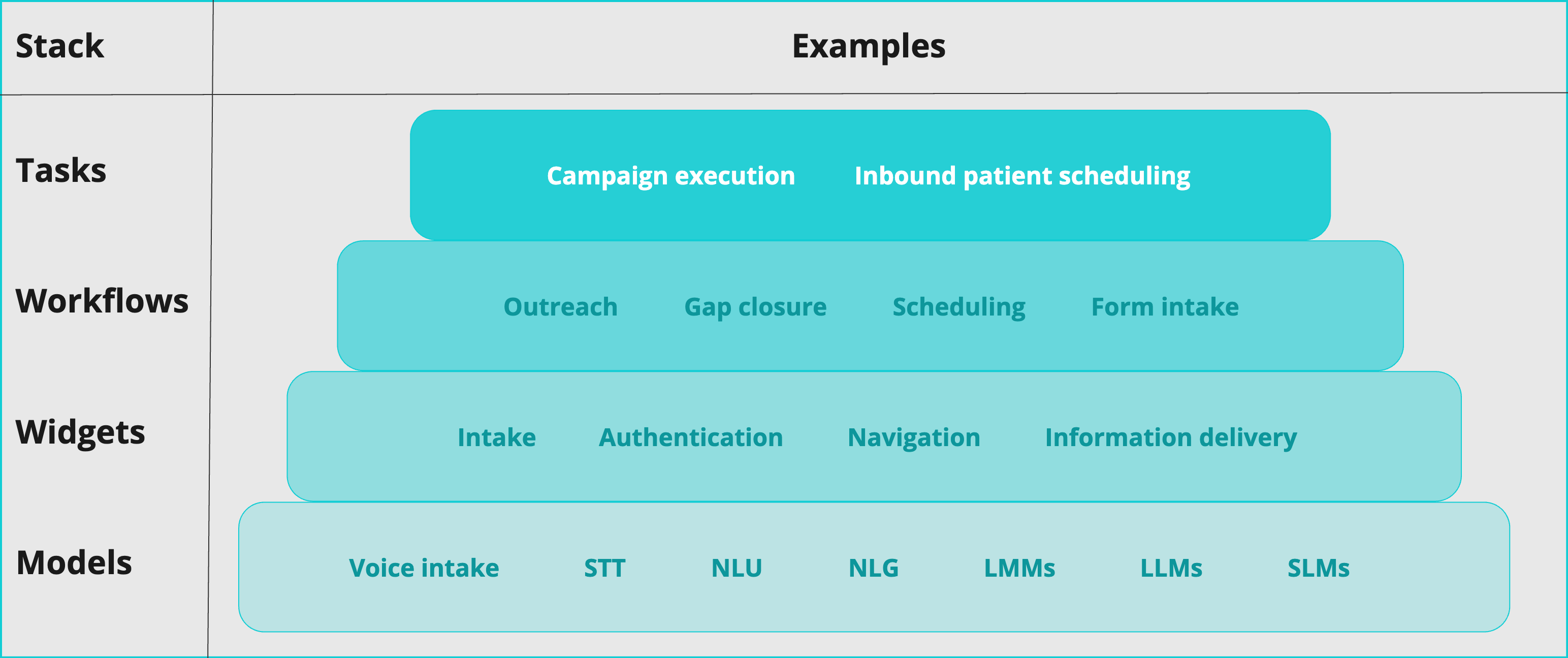
The foundation of our software stack is the Models layer. This layer comprises various models that empower our AI agents with the necessary capabilities. These models include:
- Voice Intake: Enables the agent to process and understand voice inputs.
- NLU (Natural Language Understanding): Allows the agent to comprehend and interpret user inputs.
- NLG (Natural Language Generation): Facilitates the generation of human-like responses.
- LMMs (Large Multimodal Models): Integrates multiple data types for comprehensive understanding.
- LLMs (Large Language Models): Provides advanced language processing capabilities.
- SLMs (Specialized Language Models): Tailored for specific healthcare-related language processing.
The Widgets layer consists of small, task-specific components that perform essential functions. These widgets are designed to handle individual tasks within the healthcare system. Examples include:
- Intake: Manages the initial data collection from patients.
- Authentication: Verifies patient identity against Electronic Health Records (EHR).
- Navigation: Guides users through various processes.
- Information Delivery: Provides relevant information to users.
The Workflows layer is a collection of widgets organized to perform more complex tasks. Each workflow is a sequence of widgets that work together to achieve a specific goal. For instance:
- Outreach: Engages with patients for follow-ups or reminders.
- Gap Closure: Identifies and addresses gaps in patient care.
- Scheduling: Manages appointment scheduling, including patient authentication and time negotiation.
- Form Intake: Handles the collection and processing of patient forms.
The Tasks layer involves the deployment and management of workflows. This layer orchestrates the execution of workflows to accomplish broader objectives. Examples of tasks include:
- Campaign Execution: Implements outreach campaigns to engage with multiple patients.
- Inbound Patient Scheduling: Manages incoming scheduling requests and coordinates appointments.
- Bulk Calls: Executes large-scale calling operations to reach numerous patients.
- Stacking Workflows: Combines multiple workflows to achieve complex tasks.
By leveraging this structured stack, our AI agents can efficiently automate various aspects of user engagement within healthcare systems, ensuring a seamless and effective interaction experience for patients and healthcare providers alike.